



이 기사는 2026년11월19일 07시00분에 팜이데일리 프리미엄 콘텐츠로 선공개 되었습니다.
[Sungjin Kim, Edialy Reporter] South Korean pharmaceutical and biotechnology stocks showed sharply contrasting performances on November 18, as investors reacted to clinical trial results, drug commercialization prospects and regulatory developments.
Aribio Lab and Aribio Holdings, both of which had plunged nearly 30% in the previous trading session, staged strong rebounds as investors reassessed the Phase 3 clinical trial results of an oral Alzheimer's disease drug candidate. Samjin Pharm, the second-largest shareholder of Aribio, also surged after reaffirming its commitment to commercializing the treatment.
Inventera advanced sharply following news that it was preparing to seek domestic approval for a magnetic resonance imaging (MRI) contrast agent. Meanwhile, Sam Chun Dang Pharm suffered substantial losses amid regulatory uncertainty surrounding the U.S. approval process for SCD411, its biosimilar version of the retinal disease treatment Eylea.
Aribio Lab and Aribio Holdings Rebound as Investors Reassess Phase 3 Results
According to KG Zeroin's MP Doctor market data service, Aribio Lab shares surged 29.98% to close at 5,290 won on November 18, hitting the daily upper price limit. Aribio Holdings also jumped 21.68% to finish at 3,115 won.
ㅂ
|

The sharp rebounds followed steep losses in the previous session, when Aribio Lab and Aribio Holdings had fallen 29.95% and 29.86%, respectively.
The dramatic volatility reflects investors' conflicting interpretations of the global Phase 3 clinical trial results for AR1001, an oral Alzheimer's disease treatment candidate being developed by Aribio.
On November 17, Aribio presented topline results from its global Phase 3 POLARIS-AD trial at the Clinical Trials on Alzheimer's Disease (CTAD 2026) conference in Boston.
The announcement initially triggered a negative market reaction, sending related stocks toward their daily lower price limits. Just one day later, however, investor sentiment reversed sharply, pushing Aribio Lab shares to the upper limit.
The initial disappointment stemmed largely from differences in treatment efficacy across patient populations.
The POLARIS-AD trial evaluated two overlapping patient populations: a monotherapy subgroup of 604 patients who were not receiving existing Alzheimer's medications, and an overall study population of 1,535 patients that included the monotherapy subgroup. Patients outside the monotherapy subgroup were receiving existing symptomatic treatments, including acetylcholinesterase inhibitors and memantine.
The trial demonstrated statistically significant efficacy in the monotherapy subgroup but failed to establish statistical significance in the overall population.
Among patients receiving AR1001 as monotherapy, deterioration in Clinical Dementia Rating–Sum of Boxes (CDR-SB) scores was approximately 31% lower than in the placebo group. The difference in score changes between the two groups was -0.44 points, achieving statistical significance (p=0.0266).
In contrast, the treatment difference in the overall population was only -0.11 points and did not reach statistical significance (p=0.4015).
These mixed findings raised questions about the drug's overall effectiveness and contributed to the sharp declines in Aribio-related stocks immediately after the announcement.
Investor sentiment subsequently improved as attention shifted to the trial's prespecified statistical success criteria.
According to the company, the study was designed so that meeting the primary efficacy threshold in either the monotherapy subgroup or the overall population would satisfy the trial's primary objective. Aribio said this statistical approach had been discussed with regulatory authorities during the clinical development planning process.
The significance threshold allocated to the monotherapy subgroup was 0.03. With a reported p-value of 0.0266, the subgroup met that prespecified criterion.
An expert in neurological drug development said the lack of statistical significance in the overall population might not necessarily prevent further development.
"Even if statistical significance was not achieved in the overall population, I do not see it as a major problem," the expert said. "If the treatment effect is clearly demonstrated in the monotherapy subgroup, one potential approach would be to seek approval for an indication limited to patients who are not taking existing Alzheimer's medications."
Nevertheless, achieving the trial's prespecified statistical success criteria does not guarantee regulatory approval from the U.S. Food and Drug Administration (FDA).
Given the failure to demonstrate statistical significance in the overall population, a key question is whether the FDA will accept the monotherapy subgroup results as sufficient evidence for approval or require an additional clinical trial.
Samjin Pharm Jumps More Than 18% After Reaffirming AR1001 Commercialization Plans
Samjin Pharm, Aribio's second-largest shareholder and the holder of exclusive domestic manufacturing and sales rights for AR1001, also recorded substantial gains.
|
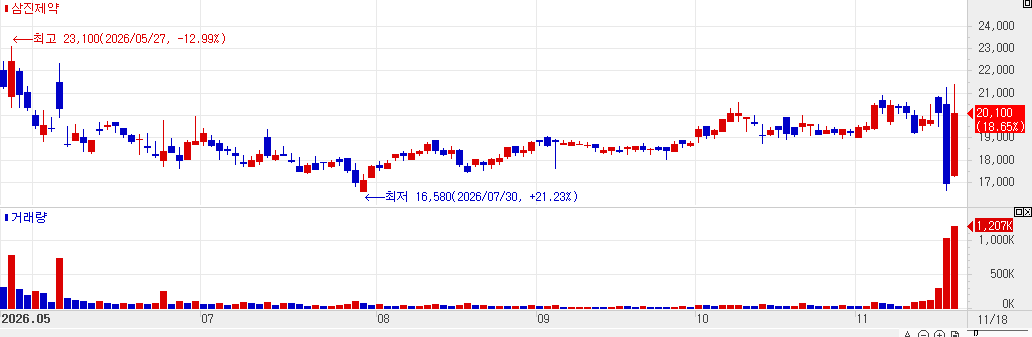
Its shares rose 18.65% to close at 20,100 won, rebounding from a 15.93% decline in the previous session.
The rally followed Samjin Pharm's announcement that it considered the Phase 3 trial successful and intended to accelerate subsequent development and commercialization efforts.
On November 18, the company said the trial had produced positive findings not only for the primary endpoint in the monotherapy subgroup but also for certain secondary endpoints and biomarkers.
In particular, Samjin Pharm reported a statistically significant 0.7-point difference versus placebo on the Mini-Mental State Examination (MMSE). It also reported a significant reduction in p-tau217, a biomarker associated with Alzheimer's disease.
The strategic relationship between Samjin Pharm and Aribio dates back to 2022.
In May of that year, the two companies signed a memorandum of understanding to collaborate on research and development of treatments for intractable and neurodegenerative diseases.
They subsequently formed a strategic pharmaceutical and biotechnology alliance in August 2022, accompanied by reciprocal equity investments.
At the time, Samjin Pharm invested approximately 30 billion won in Aribio, while Aribio acquired approximately 30 billion won worth of Samjin Pharm shares, establishing a long-term strategic partnership.
Their cooperation expanded further in March 2023, when Samjin Pharm signed an agreement worth up to 100 billion won covering joint participation in AR1001's domestic Phase 3 clinical trial and exclusive manufacturing and sales rights in South Korea.
Under the agreement, Samjin Pharm paid an upfront fee of 10 billion won.
Additional payments include 20 billion won upon completion of the domestic clinical trial and fulfillment of specified conditions, 30 billion won following regulatory approval, and up to 40 billion won in sales-related milestone payments after commercialization.
As of the end of June 2026, Samjin Pharm held 1,443,492 Aribio shares, representing a 5.47% ownership stake.
If AR1001 secures regulatory approval in South Korea, Samjin Pharm could benefit both from the value of its equity investment and from potential revenue generated through domestic manufacturing and sales.
However, the timing and scale of any commercialization-related returns will depend on the drug's regulatory progress and eventual market performance.
Inventera Surges on Preparations for MRI Contrast Agent Approval
Inventera shares gained 18.95% to close at 8,350 won on November 18. The stock rose as high as 8,880 won during the session, representing an intraday increase of more than 26%.
|
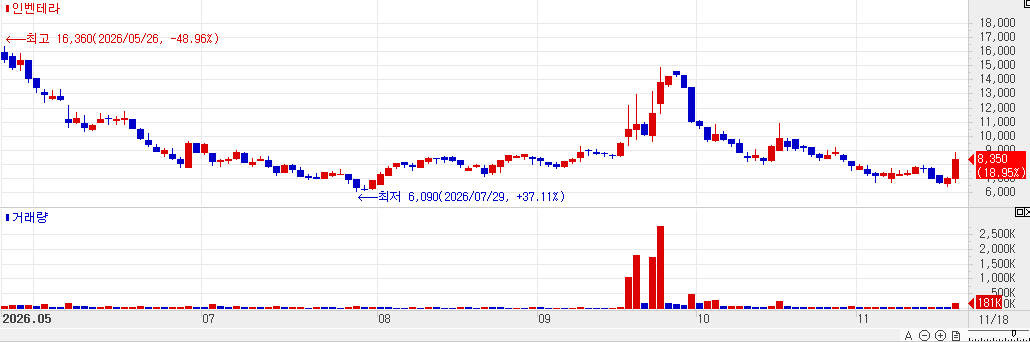
The rally followed the company's November 17 announcement concerning Asolux Injection (INV-002), a nano-based MRI contrast agent candidate being developed for MR arthrography.
Inventera said it had requested a pre-New Drug Application (Pre-NDA) consultation meeting with South Korea's Ministry of Food and Drug Safety (MFDS).
A Pre-NDA meeting is a regulatory consultation conducted before a formal marketing authorization application. It allows developers to discuss clinical, nonclinical and quality-related documentation, as well as potential issues that may arise during the approval process.
Inventera previously conducted a Phase 3 clinical trial of Asolux involving 85 patients with confirmed or suspected shoulder joint disorders.
The trial was carried out at eight major South Korean hospitals, including Seoul National University Bundang Hospital.
Asolux differs from conventional MRI contrast agents primarily through its use of iron rather than gadolinium, which is commonly used in existing products.
The candidate is specifically designed for MR arthrography and can be administered directly into the joint cavity without a separate dilution process.
Inventera obtained the clinical study report (CSR) for its Phase 3 trial in September.
The company plans to use the regulatory consultation to review the materials required for a formal marketing authorization application.
However, the consultation request represents a preparatory step rather than the commencement of a formal regulatory review.
The timing of the actual application and the MFDS's subsequent assessment remain important factors in determining the product's commercialization prospects.
Sam Chun Dang Pharm Plunges Nearly 15% Amid FDA Concerns Over SCD411
Sam Chun Dang Pharm shares tumbled 14.56% to close at 137,300 won on November 18.
|
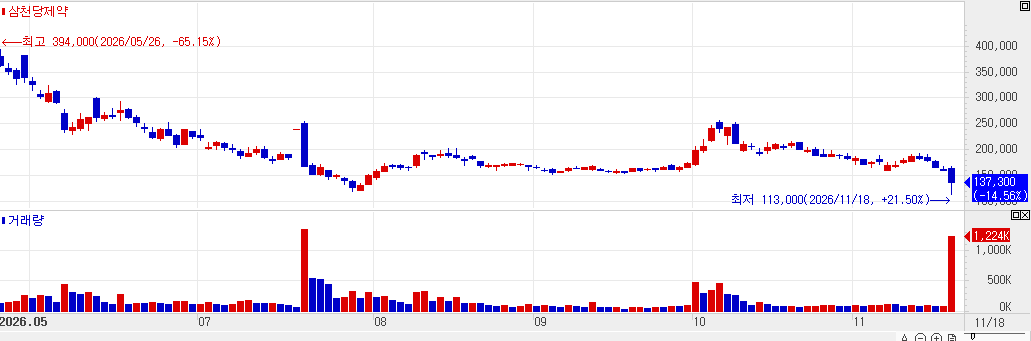
Earlier in the session, the stock fell as low as 113,000 won, approaching its daily lower price limit of 112,500 won.
The selloff was linked to regulatory uncertainty surrounding SCD411, the company's biosimilar version of Eylea, a treatment for retinal diseases including wet age-related macular degeneration.
According to Sam Chun Dang Pharm, the FDA issued a Complete Response Letter (CRL) on August 18, 2026, during the review of SCD411's marketing application.
A CRL is issued when the FDA determines that it cannot approve a New Drug Application (NDA) or Biologics License Application (BLA) in its current form and requires the applicant to address outstanding deficiencies.
Sam Chun Dang Pharm said the FDA had not identified any critical findings during its facility inspection and that the CRL contained one request for corrective action.
"The company completed the required corrective measures and resubmitted its response to the FDA on November 6," Sam Chun Dang Pharm said.
The company added that the FDA had also requested documentation typically associated with the approval process, including updated prescribing information and package labeling, resubmission of the proposed product name, and updated safety information.
It emphasized that the CRL did not require additional clinical trials to demonstrate biosimilarity.
SCD411 is a biosimilar candidate referencing Eylea (aflibercept), a retinal disease treatment marketed by Regeneron Pharmaceuticals and Bayer.
Eylea is used to treat conditions including wet age-related macular degeneration and diabetic macular edema. It works by inhibiting vascular endothelial growth factor (VEGF) and related pathways that contribute to abnormal blood vessel growth and fluid leakage in the retina.
The drug is administered through an intravitreal injection directly into the eye.
Sam Chun Dang Pharm has completed a global Phase 3 clinical trial of SCD411 and is pursuing regulatory approval in major markets, including the United States.
Although the company said it had addressed the FDA's requested corrective action and resubmitted the relevant documentation, the regulator must still assess whether the response is sufficient.
Consequently, uncertainty remains over the timing of a potential U.S. approval.