


“Open Dissent, Rather Than Unanimity, Raises the Credibility of Monetary Policy” [ESF2026]
[Sub-Title]
Day 2 of the 17th Edaily Strategy Forum
Andrew Levin, Professor of Economics at Dartmouth College
“Monetary policymaking increasingly requires dissenting views and opposing votes.”
Jin-il Kim, Member of the Monetary Policy Board, Bank of Korea
“Central bank communication becomes more important in an era of uncertainty”
[Edaily By Reporter Yeon-seo Kim and Da-won Lee] As economic uncertainty deepens, it was suggested that open dissent and opposing votes inside central bank monetary policy decisions are becoming more important. It was pointed out that a structure where diverse opinions are visibly manifested, rather than unanimous agreement, can enhance policy credibility.
|
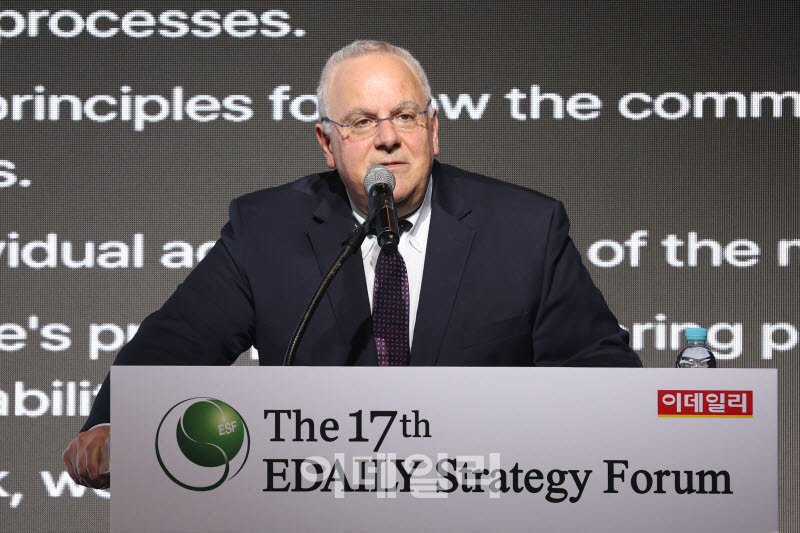
Professor Levin cited the Bank of England as a positive example, noting that “its members actively express opinions on the need for monetary tightening or easing.” In contrast, he pointed out that “Norway has made all decisions unanimously over the past 5 years. Even when differences existed, they were not revealed, creating limitations in terms of public trust and accountability.”
He subsequently pointed out, “The US Federal Open Market Committee (FOMC) failed to respond sufficiently during the period when inflation was accelerating,” adding, At the time, there was not enough active dissent or debate, and this could be seen as an example of what sociologists call ‘Groupthink.’“
Concurrently, he diagnosed that an effective monetary policy requires a culture that accepts open disagreement. ”Since each country has different economic conditions, institutions, and cultures, there is no single solution applicable to all central banks,“ he said. ”An effective monetary policy committee requires independence, transparency, accountability, and a culture that accommodates open dissent.“
|

Kim explained that central banks were once known for operating with a high degree of secrecy, but since the 1990s they have steadily shifted toward greater transparency and more proactive communication. ”In the past, central banks rarely discussed the future and left the market to analyze and figure it out on its own,“ he said. ”but recently, they have strengthened situation-dependent communication by presenting conditional forecasts and alternative scenarios.“
He also introduced the Bank of Korea‘s recent efforts to improve communication. ”The Bank of Korea has strengthened transparency requirements by expanding the disclosure of policy decisions and meeting minutes,“ he said. ”Based on the Korean language version, the minutes are released faster than those of the Federal Reserve.“
Regarding forward guidance, he evaluated it as ”an effective communication tool that can enhance the central bank’s credibility,“ explaining that ”under the zero-interest-rate lower bound where interest rates cannot be lowered further, explaining the future policy path becomes an important policy tool.“ However, he pointed out the limitations, noting, ”Conditional guidance can easily be interpreted by markets or the media as an unconditional commitment.“
Regarding the Dot Plot introduced by the Bank of Korea early this year, Member Kim stated, ”The Dot Plot is not a fixed interest rate forecast, but rather closer to a policy reaction function showing how Monetary Policy Board members would respond to changing economic conditions.“ He added, ”The Bank of Korea must clearly explain the assumptions and risks along with it so that markets do not misinterpret it as a firm commitment.“
He concluded ”There is no perfect transparency that can satisfy everyone. Nevertheless, within certain boundaries, the central bank must continuously strive to secure an appropriate level of transparency and effectively convey uncertainty.“