.png)





However, Young-jun Chun, Professor of Economics and Finance at Hanyang University and Former President of The Korean Association of Public Finance (KAPF), stressed, “While short-term indicators may appear to support the government‘s position, the IMF’s warning is by no means an exaggeration when viewed against the long-term fiscal challenges posed by rapidly accelerating population aging.”
Professor Chun argued that Korea‘s relatively favorable debt-to-GDP ratio is kind of “optical illusion.” and outlined the key fiscal reforms tasks that must be initiated immediately to secure long-term fiscal sustainability. He is scheduled to participate in a discussion session on the theme “Sustainable Taxation and Fiscal Policy in an Era of Uncertainty” at the upcoming 17th Edaily Strategy Forum on June 16-17.
|
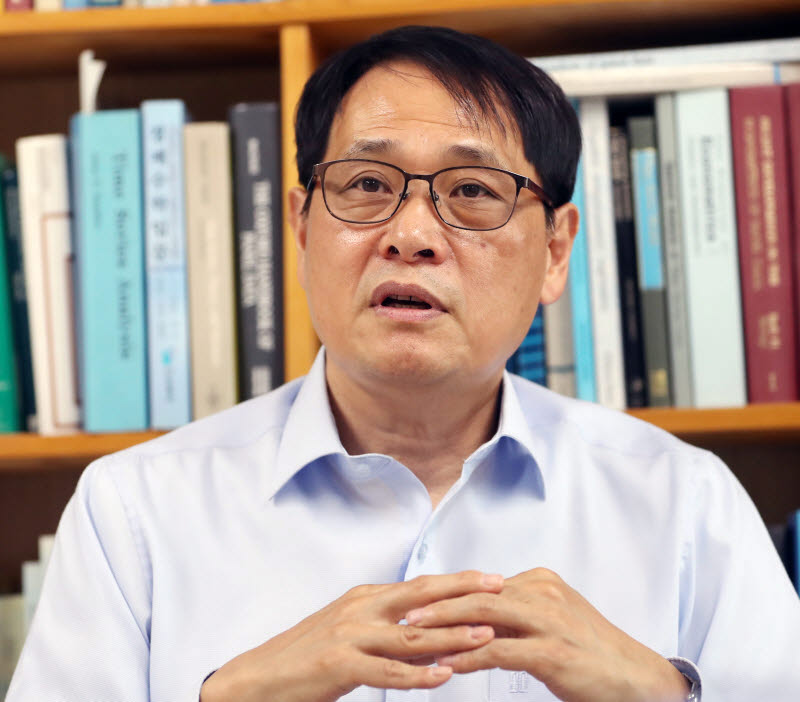
Professor Chun pointed to “unfunded pension liabilities”, which are not fully reflected in official national debt statistics, as tthe biggest fiscal risk factor. These represent the net “pure debt” calculated by subtracting expected future insurance premiums and accumulated reserves from the total pension payments owed to current participants. “The combined unfunded liabilities of public-sector pension programs, including civil servant, military, and private-school employee pensions, exceed KRW 1,000 trillion,” Chun explained. “When approximately KRW 2,000 trillion in unfunded liabilities from the National Pension Service is added, Korea’s hidden pension debt reaches roughly KRW 3,000 trillion.”
He also pointed out that the growing share of ‘mandatory spending,’ including legally mandated welfare expenditures and public sector wages, is making fiscal control increasingly difficult amid population aging. If current trends continue, Korea‘s debt-to-GDP ratio, currently around 50%, could rise to approximately 180% by 2070.
The crisis becomes even clearer when applying the European Union’s S2 Sustainability Indicator, a widely used measure of long-term fiscal health. “The S2 indicator estimates how much additional tax revenue must be raised in the future to maintain current levels of public spending. For Korea, this is estimated to be around 14%,” Professor Chun explained, “which is comparable to the levels seen in European countries that experienced severe sovereign debt crises, where S2 values were roughly 16%.” He added, “Ultimately, this is a fiscal structure in which future generations without voting rights are forced to bear the entire fiscal burden.”
“Korea Must Not Repeat Greece‘s Mistakes” A Bold Decision for a ’New Pension System‘ is Needed for the Youth“
Recalling the precedent of Greece, which deferred structural reforms only to face sovereign default and widespread riots, Professor Chun urged, ”Korea must proactively implement institutional reform before the entire fiscal system completely breaks down.“
He identified the introduction of advanced-country-style ’automatic stabilization mechanism‘ as the most urgent measure. The U.S. evaluates fiscal balance on a 75-year lifecycle basis and takes preemptive action, while Japan implemented fundamental reforms under the Koizumi administration and established a system that automatically adjusts pension benefits in response to increases in life expectancy and declines in the contributor base. While a similar mechanism has been discussed in Korea, the initiative remains stalled due to populist rhetoric prioritizing immediate income replacement rates. While a similar mechanism has been discussed in Korea, the initiative remains stalled due to populist rhetoric prioritizing immediate income replacement rates. ”A mechanism tied to life expectancy drastically enhances fiscal predictability without fundamentally undermining the total cumulative benefits received over a lifetime,“ Chun explained. ”We must strengthen political and legal enforceability so that the mandatory five-year fiscal recalculation cycle is not rendered completely toothless.“
To fundamentally resolve younger generation’s deep-rooted distrust of the National Pension Service, he proposed the ”New Pension System“ suggested by academia and policy research institutions, including the Korea Development Institute (KDI). Under this scheme, the government would gradually pay off existing accumulated pension liabilities through taxation and other public resources, while applying a ‘fully funded pension system’ for new entrants in which the present value of lifetime contributions and benefits is balanced on a one-to-one basis. He emphasized, ”Only by establishing this principle of trust can we resolve the younger generation‘s distrust. Although it will trigger enormous social controversy, strong political leadership is needed to make bold decisions and endure short-term conflict rather than suffer ongoing disputes every year.“
|
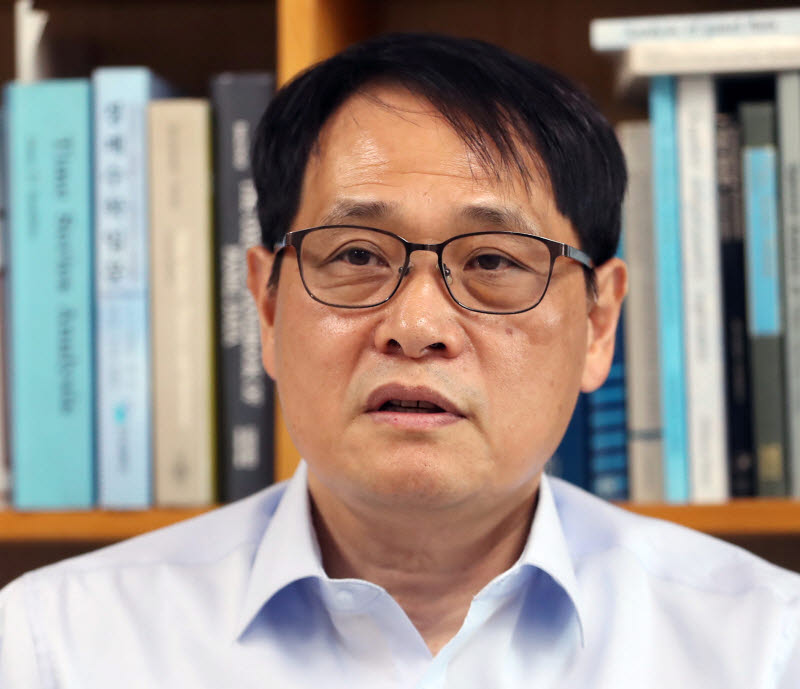
Professor Chun warned that while public attention remains largely fixated on the national pension, an even faster-moving time bomb is ticking within the National Health Insurance and Long-Term Care Insurance. This is because health insurance finances operate outside the central government budget framework, making comprehensive spending difficult to control. ”While health insurance continue performing its essential functions,“ he said. ”its total spending must be incorporated into the central government budget for proper control.“ He criticized, ”Korea is the only OECD country that continues to neglect this issue.“ He also added, ”’Fee-for-service‘ model, which structurally induces over-treatment, should shift away toward “diagnosis-related group(DRG) system” that is commonly used in advanced countries.“
He proposed a paradigm shift from politically driven ’universal welfare‘ to ’more generous targeted support‘ for low-income households,’ to o maximize the efficiency of limited fiscal resources. ”Paradoxically, when pension income replacement rates are increased, middle- and higher-income groups benefit more than lower-income groups with shorter contribution periods.“ He pointed out, ”Likewise, the basic pension, which is broadly distributed to the bottom 70% of those aged 65 and above, delivers very weak income redistribution effects.“
Furthermore, he emphasized the importance of transparency in fiscal management, particularly regarding the recurring practice of supplementary budgets. ”Rather than relying on uncertain excess tax revenues as collateral for spending, it is better for building public trust to transparently issue deficit bonds when necessary and repay them afterward,“ he said.
About Professor Young-jun Chun
△Ph.D. in Economics, University of Pennsylvania △Former Research Fellow, Korea Institute of Public Finance (KIPF) △Former Professor of Economics, Incheon National University △Former Member, National Pension System Improvement Planning Committee △Former Member, National Pension Fiscal Recalculation Committee △Former 43rd President of The Korean Association of Public Finance (KAPF) △(Current) Professor, Department of Economics and Finance, Hanyang University






![[그해 오늘] “신변보호 소용없었다”…배관 타고 6층 오른 스토킹 살해범](https://image.edaily.co.kr/images/vision/files/NP/S/2026/06/PS26061100001t.jpg)
